
Benin
Article type: Reproduction Source: wikipedia.org
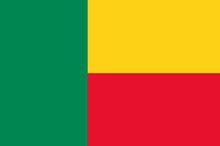
Benin, officially the Republic of Benin, is a country in West Africa. It is bordered by Togo to the west, by Nigeria to the east and by Burkina Faso and Niger to the north. A majority of the population live on its small southern coastline on theBight of Benin. The capital of Benin is Porto-Novo, but the seat of government is in Cotonou, the country's largest city. Benin covers an area of approximately 110,000 square kilometers (42,000 sq mi), with a population of approximately 9.05 million. Benin is a tropical, sub-Saharan nation, highly dependent on agriculture, with substantial employment and income arising from subsistence farming.
The official language of Benin is French. However, indigenous languages such as Fon and Yoruba are commonly spoken. The largest religious group in Benin is Roman Catholicism, followed closely by Islam, Vodun andProtestantism. Benin is a member of the United Nations, the African Union, the Organisation of Islamic Cooperation, South Atlantic Peace and Cooperation Zone, La Francophonie, the Community of Sahel-Saharan States, the African Petroleum Producers Association and the Niger Basin Authority.
From the 17th to the 19th century, modern day Benin was ruled by the Kingdom of Dahomey. This region was referred to as the Slave Coast from as early as the 17th century due to the large number of slaves shipped to the New World during the Trans-Atlantic slave trade. After slavery was abolished, France took over the country and renamed it French Dahomey. In 1960, Dahomey gained full independence from France, bringing in a democratic government for the next 12 years.
A Marxist-Leninist state called the People's Republic of Benin existed between 1972 and 1990. Many sources state this regime led to repression and the collapse of the economy. In 1991, it was replaced by the currentmulti-party Republic of Benin.
Language
Local languages are used as the languages of instruction in elementary schools, with French only introduced after several years. In wealthier cities, however, French is usually taught at an earlier age. Beninese languages are generally transcribed with a separate letter for each speech sound (phoneme), rather than using diacritics as in French or digraphs as in English. This includes Beninese Yoruba, which in Nigeria is written with both diacritics and digraphs. For instance, the mid vowels written é è, ô, o in French are written e, ɛ, o, ɔ in Beninese languages, whereas the consonants written ng and shor ch in English are written ŋ and c. However, digraphs are used for nasal vowels and the labial-velar consonants kp and gb, as in the name of the Fon language Fon gbe, and diacritics are used as tone marks. In French-language publications, a mixture of French and Beninese orthographies may be seen.
Cuisine
Beninese cuisine is known in Africa for its exotic ingredients and flavorful dishes. Beninese cuisine involves lots of fresh meals served with a variety of sauces. In southern Benin cuisine, the most common ingredient is corn, often used to prepare dough which is mainly served with peanut- or tomato-based sauces. Fish and chicken are the most common meats used in southern Beninese cuisine, but beef, goat, and bush rat are also consumed. The main staple in northern Benin isyams, often served with sauces mentioned above. The population in the northern provinces use beef and pork meat which is fried in palm or peanut oil or cooked in sauces. Cheese is used in some dishes. Couscous, rice, and beans are commonly eaten, along with fruits such as mangoes, oranges, avocados, bananas, kiwi fruit, and pineapples.
Meat is usually quite expensive, and meals are generally light on meat and generous on vegetable fat. Frying in palm or peanut oil is the most common meat preparation, and smoked fish is commonly prepared in Benin. Grinders are used to prepare corn flour, which is made into a dough and served with sauces. "Chicken on the spit" is a traditional recipe in which chicken is roasted over fire on wooden sticks. Palm roots are sometimes soaked in a jar with saltwater and sliced garlic to tenderize them, then used in dishes. Many people have outdoor mud stoves for cooking.
 plus..
| Friendship Link |
|
 |
|